
Arrest Warrants in Howard County
In Howard County, an arrest warrant is a judge's order authorizing custody. Indiana procedure requires sworn facts showing probable cause. The sworn showing must also describe the person and the matter with enough detail. A roster card is not that sworn showing, and it is not the court file either.
The Howard County Sheriff Warrants page lets the public run a text search and open card details. Its own index disclaims any completeness guarantee, update schedule, or full field layout. An empty search result cannot certify that no warrant exists.
Howard County Arrest Warrant Basis
An officer or a prosecutor brings sworn material to a judge or magistrate in Howard County. That judicial review is what separates a warrant from a bare accusation. The judge tests the facts against the legal standard and checks that the person and the offense are identified with enough particularity. Some material, like search-warrant affidavits or sealed or unexecuted documents, follows different access rules. Howard County local rules also cover warrantless arrest. There, probable-cause review must occur within 48 hours, by hearing or by affidavits. If the person bonds out first, the Sheriff files a Report of Bonding with an appearance date. That route stands on its own; it is not an arrest warrant issued after the fact.
What a Howard County Arrest Warrant Contains
A signed Howard County warrant order can name the subject, the alleged offense, the issuing court, the issue date, any bond, and the cause number. No public system puts all of that in one view. The Sheriff's index shows no visible warrant number, court, offense, bond, or status field. It is thin on detail. MyCase is built around cases, so a distinct warrant field may not appear in every record.
| Cause Number | Indiana identifier used to trace the official case |
|---|---|
| Named Subject | Identity stated in the order, which requires careful matching |
| Charge / Offense | Allegation tied to the probable-cause request |
| Issuing Court | Howard Circuit or Superior court controlling the order |
| Bond | Amount and release terms set by the judge, if any |
| Date and Status | Issue date and current status when publicly available |
Howard County Arrest Warrant Courts
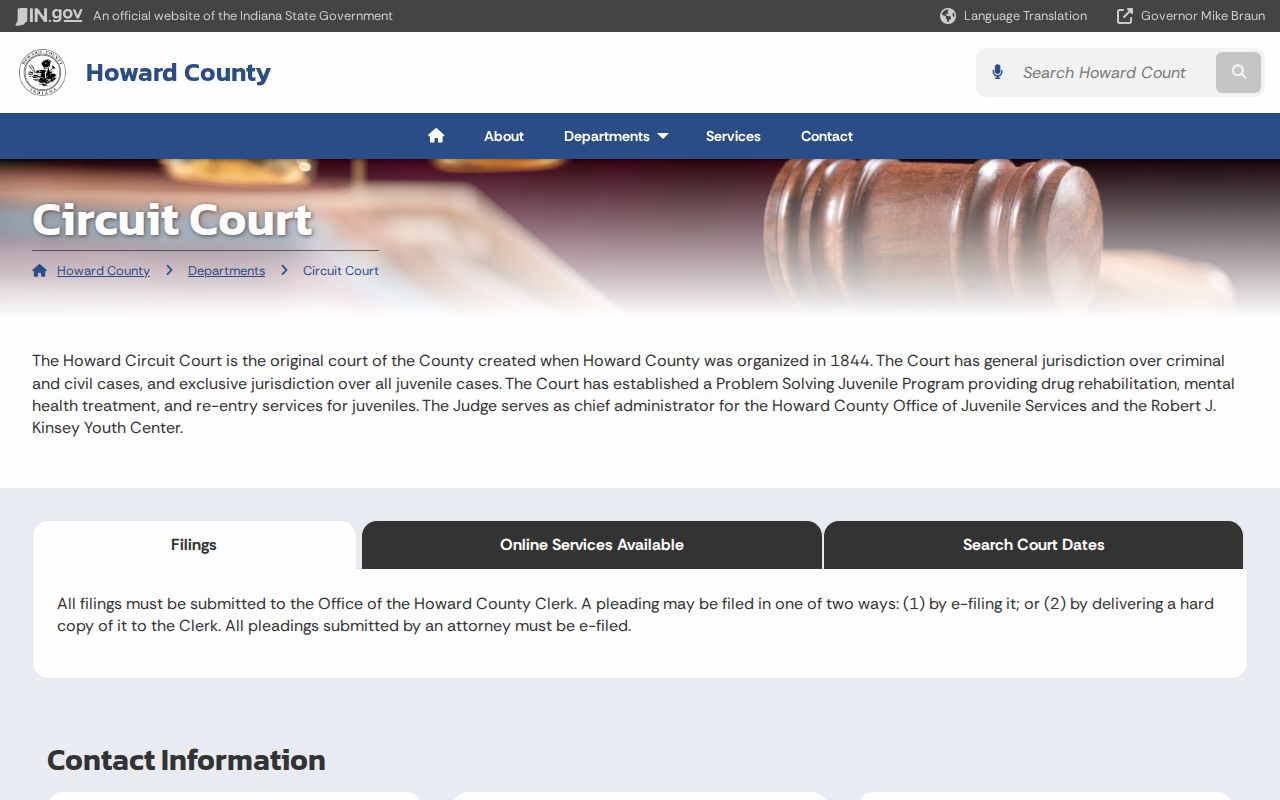
The Howard Circuit Court page lays out the court's broad jurisdiction and its courthouse contact information. It gives court-level context but no personal case data.
The cause number is still the surest way to tell which Howard County court issued a warrant. Circuit Court and Superior Courts I, II, and IV divide the general criminal docket by local assignment. Superior III takes driving offenses, infractions, and most non-drug misdemeanors. The Howard County Clerk keeps the filings and answers court-record questions at 765-456-2000. Check MyCase first for the public cause number and court, then call.
How Howard County Arrest Warrants Are Served
Service can fall to the Howard County Sheriff, a city police department, or a state agency. No official chart maps every interagency role, so confirm the serving office case by case. Sheriff Administration answers at 765-456-2020, and Records at 765-456-2024. Dispatch, 765-457-1105, is a non-emergency line rather than a dedicated warrant desk. After an arrest come booking, an initial hearing, and a bond decision where the law allows one. The jail's book-in number is not a published surrender-advice line. Before traveling anywhere, call the issuing court, the Sheriff, or a lawyer, and do not show up without a process already confirmed.
Three Howard Arrest Warrant Layers
A solid Howard County arrest warrant check works three layers: the public roster, the public court file, and a direct official response. Each layer answers a different question, so one alone is rarely enough.
Sheriff Roster
Public card interface with no stated completeness or refresh promise.
Indiana MyCase
Case search by cause number, party, court, status, and filing date.
Issuing Court
Controls the arrest warrant, bond, hearing, and recall order.
MyCase skips sealed, expunged, juvenile, and confidential files, and Indiana posts no statewide warrant roster. For a disclosable agency record, Howard County offers a public-record request form. That form still can't confirm a live warrant; only the court can.
Arrest Warrant vs Summons vs Bench Warrant
Howard County bench warrants and arrest warrants are different animals. An arrest warrant allows police to take someone into custody on probable cause. A summons skips that step. It just orders a court appearance. In Howard County, a bench warrant usually comes later, after a missed hearing or a violation in an open case.
| Feature | Arrest Warrant | Summons | Bench Warrant |
|---|---|---|---|
| What It Orders | Custody | Appearance | Custody for a missed duty |
| Basis | Probable cause | Proceeding without arrest | Failure to appear or comply |
| Who Issues It | Judge or magistrate | Court under Indiana law | Judge in the existing case |
| How to Respond | Counsel, surrender, bond | Appear as directed | Recall, appearance, court order |
Howard County Arrest Warrant Access
The Indiana Access to Public Records Act opens the door to disclosable records. It carves out exemptions, though. Investigatory files can be withheld or redacted, and juvenile files stay confidential. Court records follow separate Indiana court-access rules, and search-warrant material may stay sealed before execution or under a judge's access decision. When you write a request, name the agency, the record type, and the date range. Ask for electronic delivery, and for any non-exempt part if some material gets withheld. One Howard County record released to the public does not make every affidavit or investigative detail public.
Key point: A public arrest warrant card is not the affidavit, a conviction, or a complete criminal-history record.
What to Do If There Is a Warrant for You
Find the cause number and the issuing court first. The roster, MyCase, or the Clerk can give you that. Then talk with a lawyer about the warrant, any bond, and whether an arranged surrender, a motion, or a set court date fits your case. Howard County has no universal recall form, no fixed surrender window, and no guaranteed walk-in method. The judge sets the terms case by case. Howard County rules do describe a ten percent cash bond for an Indiana resident, unless a specific order says otherwise, though that promises neither eligibility nor amount. Release usually demands that you show up, stay lawful, and give written notice of an address change within 48 hours. Break those terms and the bond can be revoked, with another warrant close behind.
Important: Speak with a lawyer and confirm Howard County procedures before surrender; never rely on a roster card or payment receipt alone.
County and Federal Warrants Differ
Howard County sits inside the Southern District of Indiana for federal matters. Federal arrest warrants never show up as Howard cases in MyCase. They live in a different system entirely. For those, you would turn to the U.S. District Court, search dockets through PACER, or check the U.S. Marshals Service. A federal warrant has its own paperwork and its own cause number. So do not read anything federal into a Howard Sheriff result. Assume nothing crosses between systems. Whatever document you are holding, start with the agency and cause number printed on it. Tax warrants sit in yet another category. The Indiana Department of Revenue uses that label for a collection process, not a criminal arrest order. A support or civil dispute may instead involve a body attachment. All of these can carry the word warrant, and any of them can end in custody-related questions. The right office and the right court still differ in each case. Before calling anyone, read the source, the cause number, and the issuing authority. For Howard County purposes, keep the route narrow. Use the Howard Sheriff roster for the county list it displays. Use MyCase for an eligible state court case. Call the Clerk for Howard County court routing, then contact the issuing court about the order itself. Counsel handles the legal advice. That sequence keeps an unrelated state, civil, or federal record from being mistaken for a Howard County arrest warrant.