
Traffic Warrants in Howard County
A traffic citation begins as a court matter with a deadline or setting. Missing the required appearance or leaving the payment issue unresolved can lead to further court action, including a warrant when the judge orders one. The public docket may describe a failure to appear, failure to pay, hearing, or order. Those entries should be read in sequence instead of assuming that every late ticket automatically has the same result.
Howard Superior Court III handles driving offenses, traffic infractions, and most misdemeanors other than drug cases. No separate Kokomo, Greentown, or Russiaville municipal warrant court was verified. A city-issued ticket may therefore route into Howard’s county court system.
Howard Traffic Warrants in Superior III
The citation or cause number identifies the actual case. Superior III lists 765-456-2220 as its phone, but official sources conflict on whether the room is 216 or 110. Call before travel. The Howard County Clerk sits at 104 N. Buckeye Street, Room 202, and handles traffic-ticket questions at 765-456-2000 on weekdays from 8:00 a.m. to 4:00 p.m.
This courthouse setup makes the Clerk the practical routing point and Superior III the key traffic venue. The judge still controls any warrant, hearing, or recall. Records staff can identify the file and payment route, but they do not replace legal advice.
How to Check for a Traffic Warrant
Begin with the citation number or cause number. The Indiana MyCase portal can search public cases by citation, party, court, status, and filing date. It is not a complete warrant database. The Sheriff’s public warrant roster supplies a second check but does not promise completeness or show a public refresh schedule.
- Search MyCase with the citation or cause number and select the Howard court when known.
- Check the Sheriff roster for its current public-facing warrant list.
- Call the Clerk or Superior III if an online result is missing, unclear, or disputed.
- Use a clear public-record request for an existing disclosable record if the normal search routes do not answer the records question.
Howard County Traffic Warrant Payment
The Indiana public traffic-payment portal is the official online citation route linked from Howard County services. It may permit a citation number or supported identity fields. Do not publish a date of birth or license number, and do not treat the payment screen as a driving-record search.
The assigned capture shows the public payment entry point with no personal data entered.
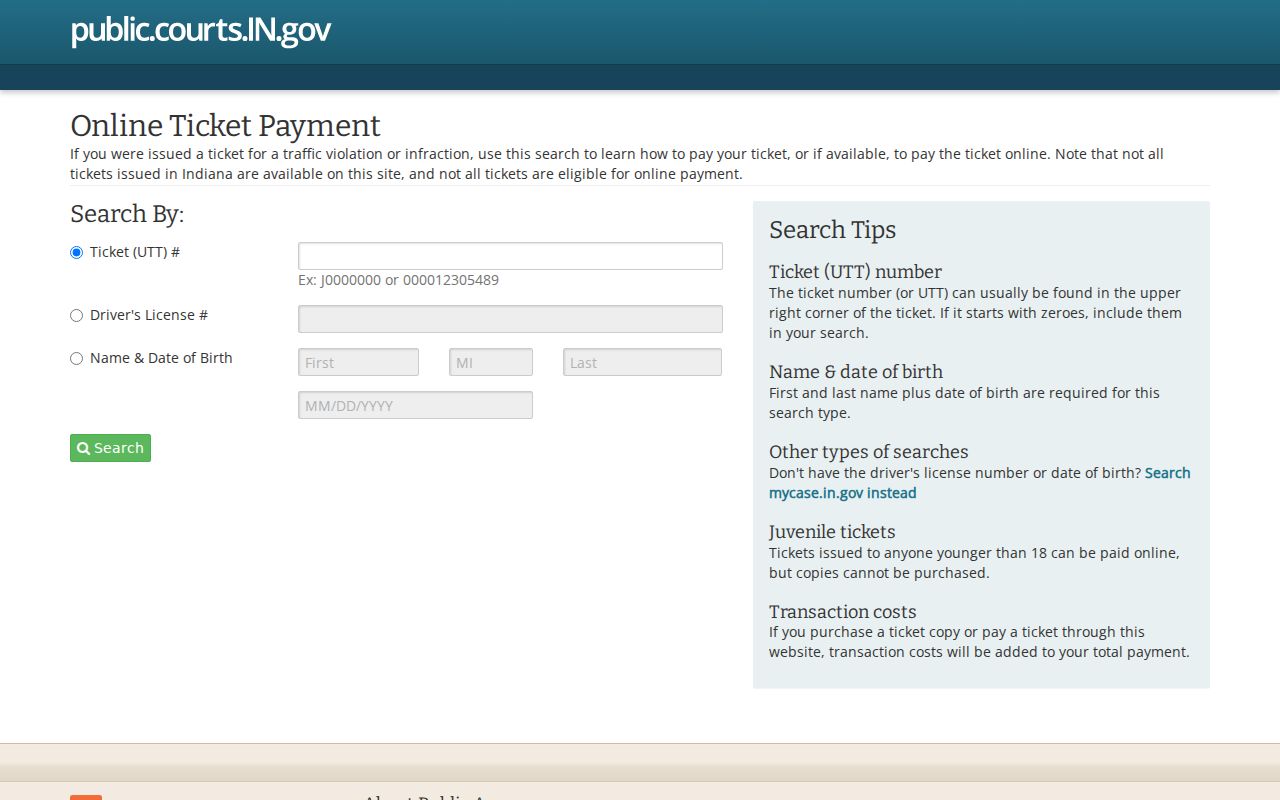
The interface helps locate an eligible citation payment. It does not establish that a separate traffic warrant was recalled or that every court balance has posted.
What a Traffic Warrant Shows
Howard traffic information is spread across a citation payment record, the public case docket, and any Sheriff roster entry. Read the citation and cause numbers first. A sample court identifier may begin with 34D03 for Superior III, but the complete number from the actual record controls. Balances can lag, and a case status does not by itself answer the warrant question.
| Citation Number | Ticket identifier used by MyCase and the payment portal |
|---|---|
| Cause Number | Official Indiana court-case identifier |
| Issuing Court | Howard court responsible for the hearing and order |
| Balance | Public financial amount that may lag the court’s current ledger |
| Status | Case, court-date, payment, and visible FTA events, each requiring context |
Howard Clerk Confirms Traffic Warrants
The official Howard County Clerk page identifies the local office that processes traffic ticket payments and court fees. Its contact block is the assigned second traffic image.
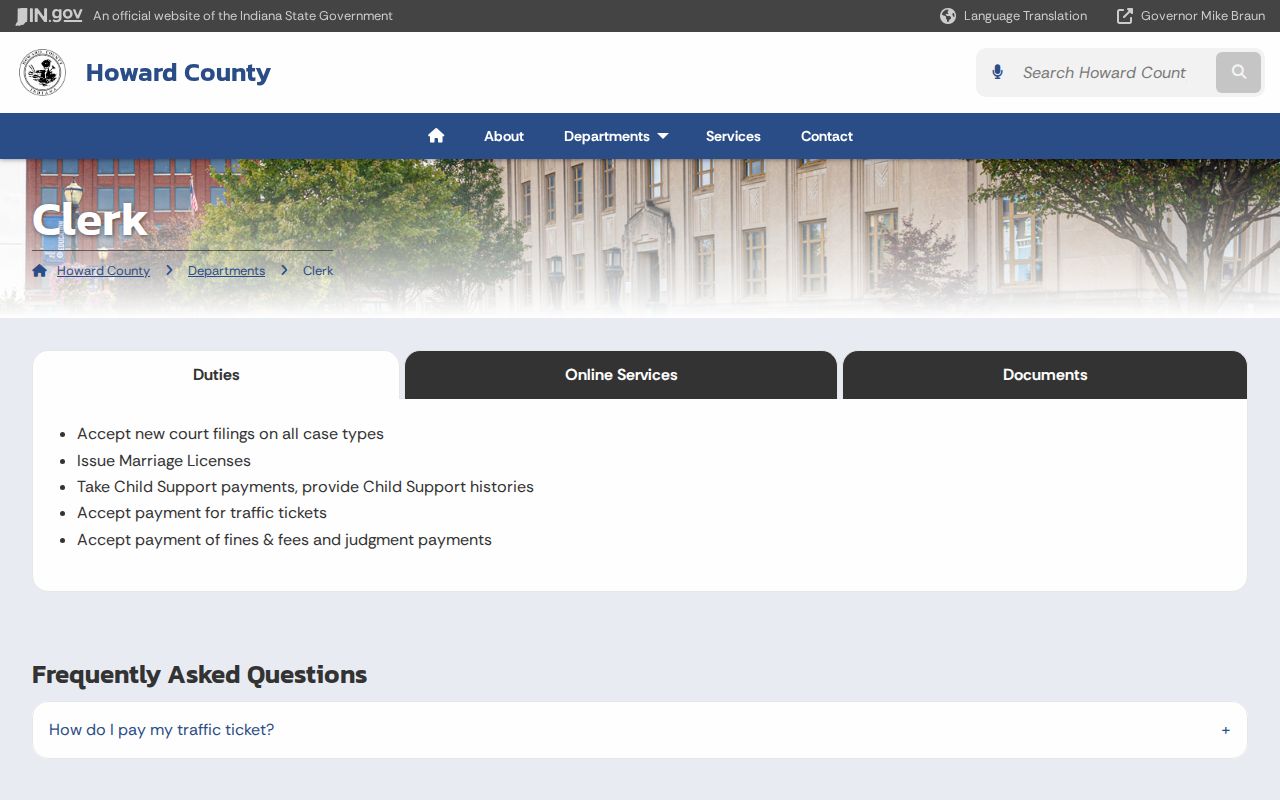
Room 202 is the county court-record routing desk. Call it to verify the court, balance, hearing, and the step still needed after any payment.
The county services hub links Pay Traffic Citation, Pay Court Fines and Fees, Court Date Lookup, and Check Active Warrants as separate tasks. That separation is useful. One vendor transaction does not answer all four questions.
Paying or Lifting a Traffic Warrant
The issuing court determines whether payment, an appearance, a bond, a motion, or another order is required. No Howard-wide warrant-recall form, universal fee, or walk-in surrender rule was located. The county-linked PayGov route handles some court fines and fees, but its captured fields and fees were not verified. Confirm the agency and case before paying.
- Confirm the citation, cause number, court, warrant, and current balance.
- Ask whether payment, an appearance, bond, or a court filing applies.
- Complete the ordered step through the official court channel.
- Confirm the court’s recall or update and then verify any separate BMV consequence.
Warning: A receipt proves a transaction, not the recall of a Howard County traffic warrant or completion of every court step.
Howard Traffic Warrants After Court
Search the citation in MyCase and note the court, cause number, missed event, and next docket entry. Call the Clerk if the record is unclear. Ask the issuing court whether it entered a warrant, scheduled another hearing, or requires a separate step. Do not assume that an empty Sheriff search settles the issue.
If Indiana BMV shows a suspension consequence, resolve the court matter first and follow the official BMV reinstatement instructions that apply. The court reports the needed appearance, payment, or resolution. The BMV consequence is downstream from the case. It does not turn this process into a driving-history or insurance inquiry.
Traffic Warrant vs FTA and License Holds
A warrant, failure-to-appear event, and license suspension are connected but distinct. Howard and Indiana sources use “bench warrant” or “warrant for failure to appear,” not the Texas phrase “capias pro fine.” A body attachment is another distinct court process. Use the exact wording in the Howard docket.
| Mechanism | What Triggers It | What It Does |
|---|---|---|
| Traffic warrant | Court acts on an unresolved citation or missed duty | Authorizes custody under the order |
| Failure to appear | A required traffic setting is missed | Creates a docket event and may lead to a warrant |
| License suspension | Court reports failure to appear or pay to BMV | Affects driving privilege until official resolution |
Howard Traffic Warrant MyCase Limits
The MyCase help page warns that public records can contain errors or omissions and that financial data may lag. Confidential, sealed, juvenile, expunged, and unavailable material will not appear. An open or closed case filter describes the public case result, not a stand-alone warrant-clearance decision.
Use online tools to collect the identifiers needed for a direct question. Then ask the Howard Clerk or issuing court whether the traffic warrant is active, what order controls it, and when the court will report an update. This final confirmation is the part a payment screen cannot supply.
A name search is less precise than a citation or cause number. Common names can produce unrelated cases, while a date filter can omit an older filing. The official MyCase search tips also describe court and status filters, wildcard tools, and a result cap. Use those aids only to find the person’s own or an authorized family matter, then compare the docket details with the original citation.
Keep copies of the citation, court instructions, transaction receipt, and later status confirmation. Each proves a different step. If the public balance conflicts with the court’s answer, ask the Clerk to identify the controlling record rather than sending a second payment. If BMV status remains unchanged after the court reports resolution, follow the official Indiana BMV traffic-violation route for the next agency step.